Best Exercises After a Car Accident: Safe Recovery Movements
Gentle, targeted exercise is crucial for recovering from car accident injuries. Learn which movements support healing and which ones to avoid during each phase of recovery.
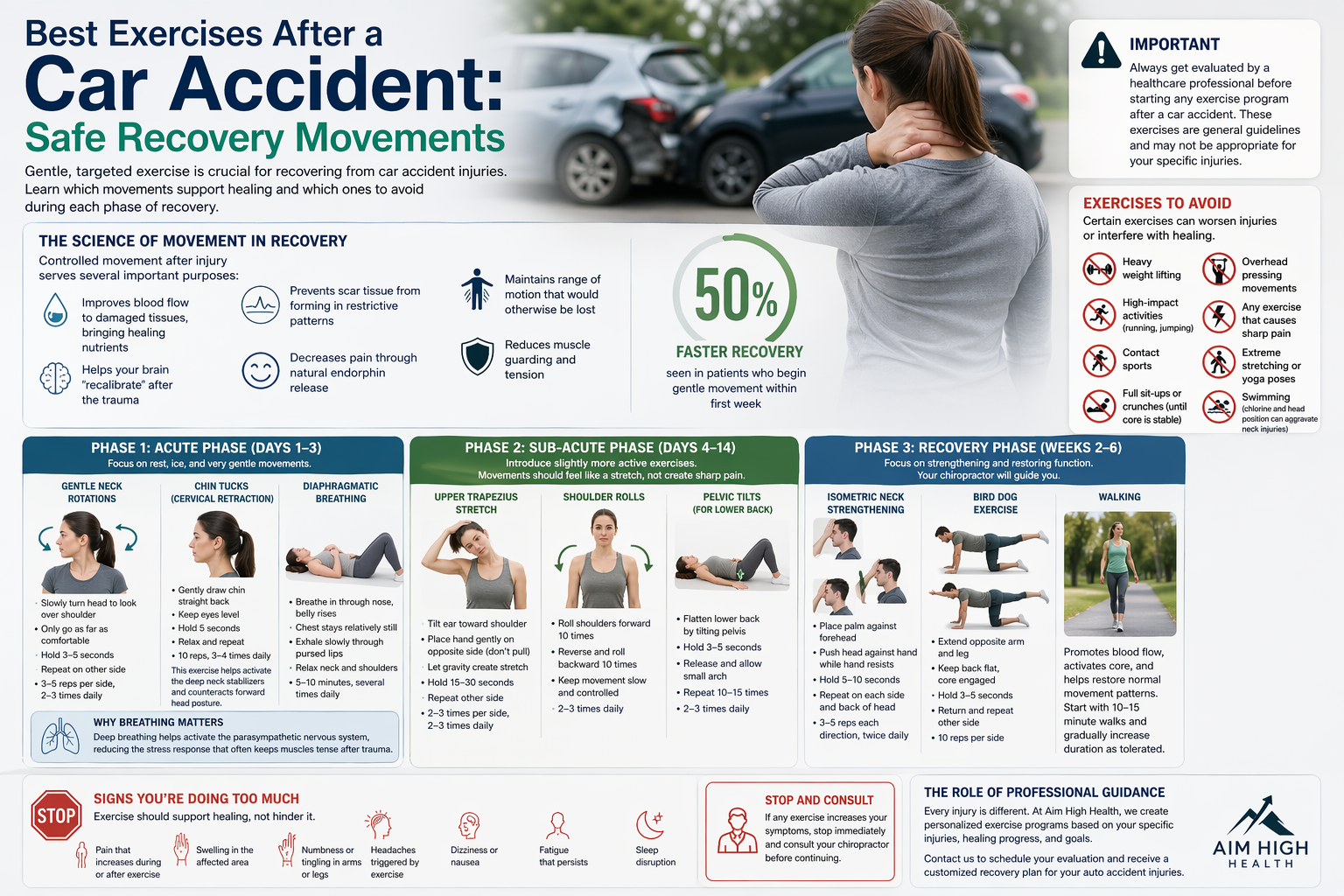
After a car accident, your instinct might be to rest completely until the pain goes away. While rest is important in the first few days, research shows that appropriate movement actually accelerates healing and prevents chronic pain. The key is knowing which exercises are safe for your specific injuries and when to introduce them.
Important
Always get evaluated by a healthcare professional before starting any exercise program after a car accident. These exercises are general guidelines and may not be appropriate for your specific injuries.
The Science of Movement in Recovery
Controlled movement after injury serves several important purposes:
- Improves blood flow to damaged tissues, bringing healing nutrients
- Prevents scar tissue from forming in restrictive patterns
- Maintains range of motion that would otherwise be lost
- Reduces muscle guarding and tension
- Helps your brain 'recalibrate' after the trauma
- Decreases pain through natural endorphin release
50%
faster recovery
seen in patients who begin gentle movement within first week
Phase 1: Acute Phase (Days 1-3)
During the first 72 hours after your accident, focus on rest, ice, and very gentle movements. This is not the time for aggressive exercise.
Gentle Neck Rotations
- Sit comfortably with shoulders relaxed
- Very slowly turn head to look over right shoulder
- Only go as far as comfortable—stop before pain
- Hold for 3-5 seconds
- Slowly return to center
- Repeat on left side
- Perform 3-5 repetitions per side, 2-3 times daily
Chin Tucks (Cervical Retraction)
- Sit or stand with good posture
- Gently draw your chin straight back (like making a double chin)
- Keep your eyes level—don't look up or down
- Hold for 5 seconds
- Relax and repeat
- Perform 10 repetitions, 3-4 times daily
This exercise is particularly important for whiplash as it activates the deep neck stabilizers and counteracts forward head posture.
Diaphragmatic Breathing
- Lie on your back with knees bent
- Place one hand on chest, one on belly
- Breathe in slowly through nose, letting belly rise
- Chest should stay relatively still
- Exhale slowly through pursed lips
- Focus on relaxing neck and shoulders with each exhale
- Practice for 5-10 minutes, several times daily
Why Breathing Matters
Deep breathing helps activate the parasympathetic nervous system, reducing the stress response that often keeps muscles tense after trauma.
Phase 2: Sub-Acute Phase (Days 4-14)
As acute inflammation subsides, you can introduce slightly more active exercises. Pain should guide you—these movements should feel like a stretch, not create sharp pain.
Upper Trapezius Stretch
- Sit with good posture
- Tilt right ear toward right shoulder
- Place right hand gently on left side of head (don't pull)
- Let gravity create the stretch in the left neck/shoulder
- Hold 15-30 seconds
- Repeat on opposite side
- Perform 2-3 times per side, 2-3 times daily
Shoulder Rolls
- Stand or sit with arms relaxed at sides
- Slowly roll shoulders forward in a circular motion
- Complete 10 forward circles
- Reverse direction for 10 backward circles
- Keep movement slow and controlled
- Repeat 2-3 times daily
Pelvic Tilts (for Lower Back)
- Lie on back with knees bent, feet flat on floor
- Flatten your lower back against the floor by tilting pelvis
- Hold for 3-5 seconds
- Release and allow a small arch in lower back
- Repeat 10-15 times
- Perform 2-3 times daily
Phase 3: Recovery Phase (Weeks 2-6)
As your body heals, exercises can become more strengthening-focused. Your chiropractor will guide you based on your specific recovery progress.
Isometric Neck Strengthening
- Place palm against forehead
- Push head against hand while hand resists (no movement)
- Hold 5-10 seconds
- Repeat with hand on each side of head and back of head
- Perform 3-5 reps in each direction, twice daily
Bird Dog Exercise
- Start on hands and knees
- Extend right arm forward and left leg backward
- Keep back flat and core engaged
- Hold 3-5 seconds
- Return to starting position
- Repeat with opposite arm/leg
- Perform 10 reps per side
Walking
Don't underestimate the power of walking. It promotes blood flow throughout the body, gently activates core stabilizers, and helps restore normal movement patterns. Start with 10-15 minute walks and gradually increase duration as tolerated.
Exercises to AVOID After a Car Accident
Certain exercises can worsen injuries or interfere with healing. Avoid these until cleared by your healthcare provider:
- Heavy weight lifting
- High-impact activities (running, jumping)
- Contact sports
- Full sit-ups or crunches (until core is stable)
- Overhead pressing movements
- Any exercise that causes sharp pain
- Extreme stretching or yoga poses
- Swimming (chlorine and head position can aggravate neck injuries)
Signs You're Doing Too Much
Exercise should support healing, not hinder it. Watch for these warning signs:
- Pain that increases during or after exercise
- Swelling in the affected area
- Numbness or tingling in arms or legs
- Headaches triggered by exercise
- Dizziness or nausea
- Fatigue that persists long after exercise
- Sleep disruption
Stop and Consult
If any exercise increases your symptoms, stop immediately and consult your chiropractor before continuing.
The Role of Professional Guidance
While these exercises are generally safe for most auto accident injuries, every injury is different. At Aim High Health, we create personalized exercise programs based on your specific injuries, healing progress, and goals. Contact us to schedule your evaluation and receive a customized recovery plan for your auto accident injuries.

Diagnóstico Claro. Tratamiento Dirigido. Progreso Monitoreado.
Desde imágenes digitales hasta tratamiento práctico, cada paso está documentado y medido. Sin conjeturas.
Aim High Health Team, Auto Injury Specialist